


Middle East and Africa Bio-Based Lubricants Market: Industry Analysis and Forecast to 2032
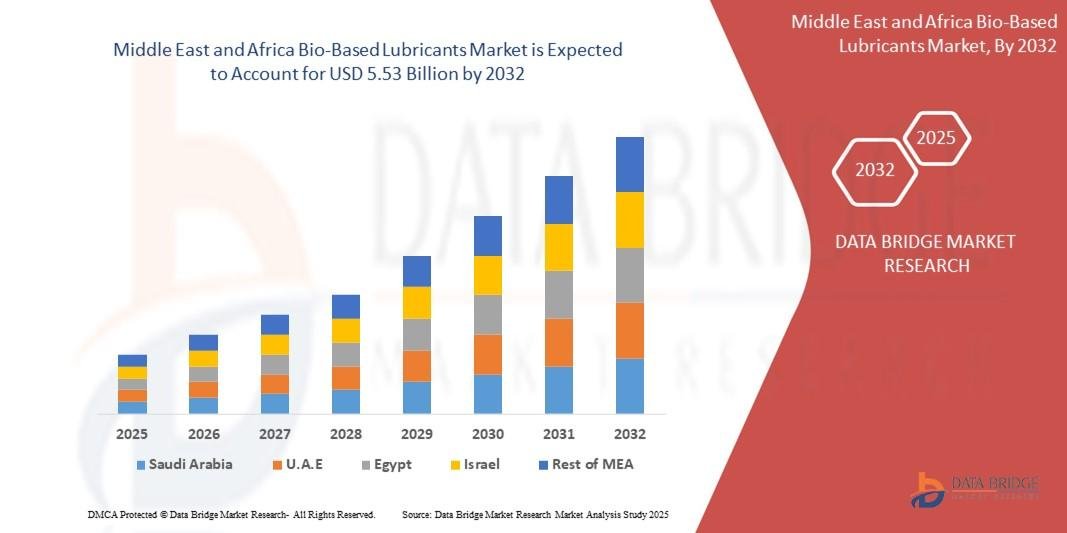
"Middle East and Africa Bio-Based Lubricants Market Summary:
According to the latest report published by Data Bridge Market Research, the Middle East and Africa Bio-Based Lubricants Market
CAGR Value
The Middle East and Africa Bio-Based Lubricants Market size was valued at USD 3.5 billion in 2024 and is expected to reach USD 5.53 billion by 2032, at a CAGR of 5.8 % during the forecast period
With the use of integrated approaches and latest technology for the best results, Middle East and Africa Bio-Based Lubricants Market research report is generated. Efficient and advanced tools and techniques are used to prepare this report that includes SWOT analysis and Porter's Five Forces Analysis. It gives top to bottom examination of the market for estimating income, return on investment (ROI) and developing business strategies. Emerging product trends, major drivers, challenges and opportunities in the market are identified and analysed apparently while generating this report. Middle East and Africa Bio-Based Lubricants Market document helps customers or other market participants to be aware of the problems they may face while operating in this market over a longer period of time.
Stay informed with our latest keyword market research covering strategies, innovations, and forecasts. Download full report: https://www.databridgemarketresearch.com/reports/middle-east-and-africa-bio-based-lubricants-market
Middle East and Africa Bio-Based Lubricants Market Segmentation and Market Companies
Segments
- By Type: The Middle East and Africa bio-based lubricants market can be segmented based on type into vegetable oil based, animal fat based, and others. Vegetable oil based lubricants are gaining traction in the market due to their environmentally friendly nature and biodegradability. These lubricants are derived from renewable resources such as soybean, palm, rapeseed, and sunflower oils. Animal fat based lubricants are another segment that offers sustainable and bio-based alternatives to traditional petroleum-based lubricants. The others segment includes lubricants derived from sources such as algae and microbial oils.
- By Application: In terms of application, the market can be segmented into automotive, industrial, marine, and others. The automotive segment holds a significant share in the market as bio-based lubricants are increasingly being used in automobiles to reduce greenhouse gas emissions and environmental impact. The industrial sector also presents opportunities for bio-based lubricants due to regulations promoting the use of sustainable products. The marine industry is another key application area where bio-based lubricants find applications due to stringent environmental regulations governing maritime activities.
- By End-Use Industry: Bio-based lubricants in the Middle East and Africa are used across various end-use industries such as automotive, construction, agriculture, and others. The automotive industry is a major consumer of bio-based lubricants as vehicle manufacturers are shifting towards sustainable practices. The construction sector also utilizes bio-based lubricants in heavy machinery and equipment to reduce environmental pollution. In agriculture, bio-based lubricants are used in farm machinery for improved performance and reduced environmental impact.
Market Players
- Exxon Mobil Corporation: Exxon Mobil is a leading player in the Middle East and Africa bio-based lubricants market, offering a wide range of sustainable lubricant solutions for various applications. The company focuses on research and development to innovate bio-based products that meet customer demands and regulatory requirements.
- TotalEnergies: TotalEnergies is another key player in the market, with a strong portfolio of bio-based lubricants catering to different industries in the region. The company has a sustainable approach towards lubricant production and aims to reduce carbon footprint through its bio-based offerings.
- Shell International BV: Shell is a prominent player in the bio-based lubricants market, known for its high-quality products and commitment to sustainability. The company emphasizes the use of renewable resources in lubricant manufacturing to promote environmental conservation.
- BP p.l.c.: BP is actively involved in the bio-based lubricants market in the Middle East and Africa, offering a diverse range of eco-friendly lubricant solutions for various applications. The company's focus on sustainability and innovation drives its growth in the market.
The Middle East and Africa bio-based lubricants market showcases promising growth opportunities driven by increasing environmental awareness, stringent regulations promoting sustainability, and the shift towards renewable and biodegradable lubricant solutions. One key aspect that sets bio-based lubricants apart is their eco-friendly nature, derived from renewable resources such as vegetable oils and animal fats. These sustainable alternatives to traditional petroleum-based lubricants not only reduce greenhouse gas emissions but also contribute towards minimizing environmental impact across various industries.
Within the market segments, the type-based segmentation of bio-based lubricants into vegetable oil based, animal fat based, and other sources highlights the diversification and innovation within the industry. Vegetable oil-based lubricants, in particular, have been gaining traction due to their biodegradability and environmentally friendly characteristics. Furthermore, the inclusion of other sources such as algae and microbial oils underscores the continuous research and development efforts to expand the range of bio-based lubricant options available in the market.
In terms of applications, the automotive sector emerges as a significant consumer of bio-based lubricants, driven by the need to reduce carbon footprint and comply with regulatory requirements. The industrial and marine applications also present substantial opportunities for bio-based lubricants adoption, aligning with the growing emphasis on sustainable practices and environmental stewardship in these sectors. Moreover, the end-use industries like construction, agriculture, and others demonstrate the versatile applicability of bio-based lubricants across diverse sectors, further propelling market growth.
Market players such as Exxon Mobil Corporation, TotalEnergies, Shell International BV, and BP p.l.c. play pivotal roles in advancing the Middle East and Africa bio-based lubricants market through their extensive product offerings, research initiatives, and commitment to sustainability. These key players contribute to driving innovation, enhancing product quality, and meeting the evolving needs of customers in the region. By leveraging their expertise and technological advancements, these companies are poised to shape the landscape of bio-based lubricants industry in the Middle East and Africa, catering to the increasing demand for environmentally responsible lubricant solutions.
Overall, the Middle East and Africa bio-based lubricants market exhibit a positive growth trajectory driven by the convergence of environmental consciousness, regulatory support, and industry efforts towards sustainable practices. With the continued focus on research and development, expanding product portfolios, and strategic partnerships, the market is poised for further expansion and adoption of bio-based lubricants across various sectors, paving the way for a greener and more sustainable future in the region.The Middle East and Africa bio-based lubricants market is witnessing significant growth driven by the increasing awareness of environmental sustainability and regulatory measures promoting the adoption of eco-friendly lubricant solutions. With a focus on renewable and biodegradable alternatives to traditional petroleum-based lubricants, the market is experiencing a paradigm shift towards more sustainable practices across various industries. Bio-based lubricants derived from vegetable oils, animal fats, algae, and microbial sources offer environmentally friendly options that not only reduce greenhouse gas emissions but also minimize the overall environmental impact.
Key market segments such as type-based segmentation highlight the diversification and innovation within the bio-based lubricants industry. Vegetable oil-based lubricants are particularly gaining traction due to their biodegradability and sustainable characteristics, resonating well with the growing demand for eco-conscious products. The inclusion of animal fat-based and other sources further expands the range of bio-based lubricant options available in the market, showcasing ongoing research and development efforts to enhance product offerings and address evolving customer needs.
In terms of applications, the automotive sector emerges as a significant driver of bio-based lubricant consumption, fueled by the automotive industry's commitment to reducing carbon footprint and adhering to stringent regulatory standards. Additionally, the industrial and marine applications present lucrative opportunities for bio-based lubricants adoption, reflecting the broader shift towards sustainable practices and environmental responsibility in these sectors. The versatile applicability of bio-based lubricants across end-use industries like construction, agriculture, and others further underscores the market's potential for growth and expansion.
Major market players such as Exxon Mobil Corporation, TotalEnergies, Shell International BV, and BP p.l.c. are instrumental in advancing the Middle East and Africa bio-based lubricants market through their diverse product portfolios, research endeavors, and sustainability initiatives. These key players drive innovation, enhance product quality, and cater to the evolving needs of customers in the region, playing a crucial role in shaping the future of the bio-based lubricants industry. By leveraging their expertise, technological advancements, and strategic collaborations, these companies are poised to drive further market expansion and foster the adoption of environmentally responsible lubricant solutions across diverse sectors, contributing to a greener and more sustainable future in the Middle East and Africa.
Learn about the company’s position within the industry
https://www.databridgemarketresearch.com/reports/middle-east-and-africa-bio-based-lubricants-market/companies
Frequently Asked Questions About This Report
What is the expected exit strategy for Middle East and Africa Bio-Based Lubricants Market start-ups?
What is the difference in Middle East and Africa Bio-Based Lubricants Market utility between B2B and B2C segments?
What is the market value of the global Middle East and Africa Bio-Based Lubricants Market industry as of the most recent pay cycle?
What partnerships are currently shaping the Middle East and Africa Bio-Based Lubricants Market?
What are the potential Black Swan events for the Middle East and Africa Bio-Based Lubricants Market?
How is the shortage of skilled professionals affecting the Middle East and Africa Bio-Based Lubricants Market?
What are the major challenges the Middle East and Africa Bio-Based Lubricants Market currently faces?
Who are the key players in the Middle East and Africa Bio-Based Lubricants Market?
What are the key buying criteria for consumers in the Middle East and Africa Bio-Based Lubricants Market?
How will Hydrogen Energy change the Middle East and Africa Bio-Based Lubricants Market supply chain?
How does product-level segmentation impact the overall Middle East and Africa Bio-Based Lubricants Market CAGR?
How does currency fluctuation affect the global Middle East and Africa Bio-Based Lubricants Market?
Browse More Reports:
Global Precision Agriculture Market
Global Industrial Services Market
Global Polystyrene Market
Global Anti-Drone Market
Global Biomarkers Market
Global Cold Chain Market
Global Digital Lending Platform Market
Global Edutainment Market
Global Expanded Polystyrene Market
Global Liquefied Natural Gas (LNG) Carrier Market
Global Magnetic Resonance Imaging (MRI) Market
Global Raman Spectroscopy Market
Global Silicon Fertilizer Market
Global Talc Market
Europe Next Generation Sequencing (NGS) Market
Contact Us:
Data Bridge Market Research
US: +1 614 591 3140
UK: +44 845 154 9652
APAC : +653 1251 1001
Email:- corporatesales@databridgemarketresearch.com"

 English
 Arabic
 French
 Spanish
 Deutsch
 Turkish
 Dutch
Dutch
 Italiano
 Russian
 Romaian
 Portuguese (Brazil)
 Greek
Greek