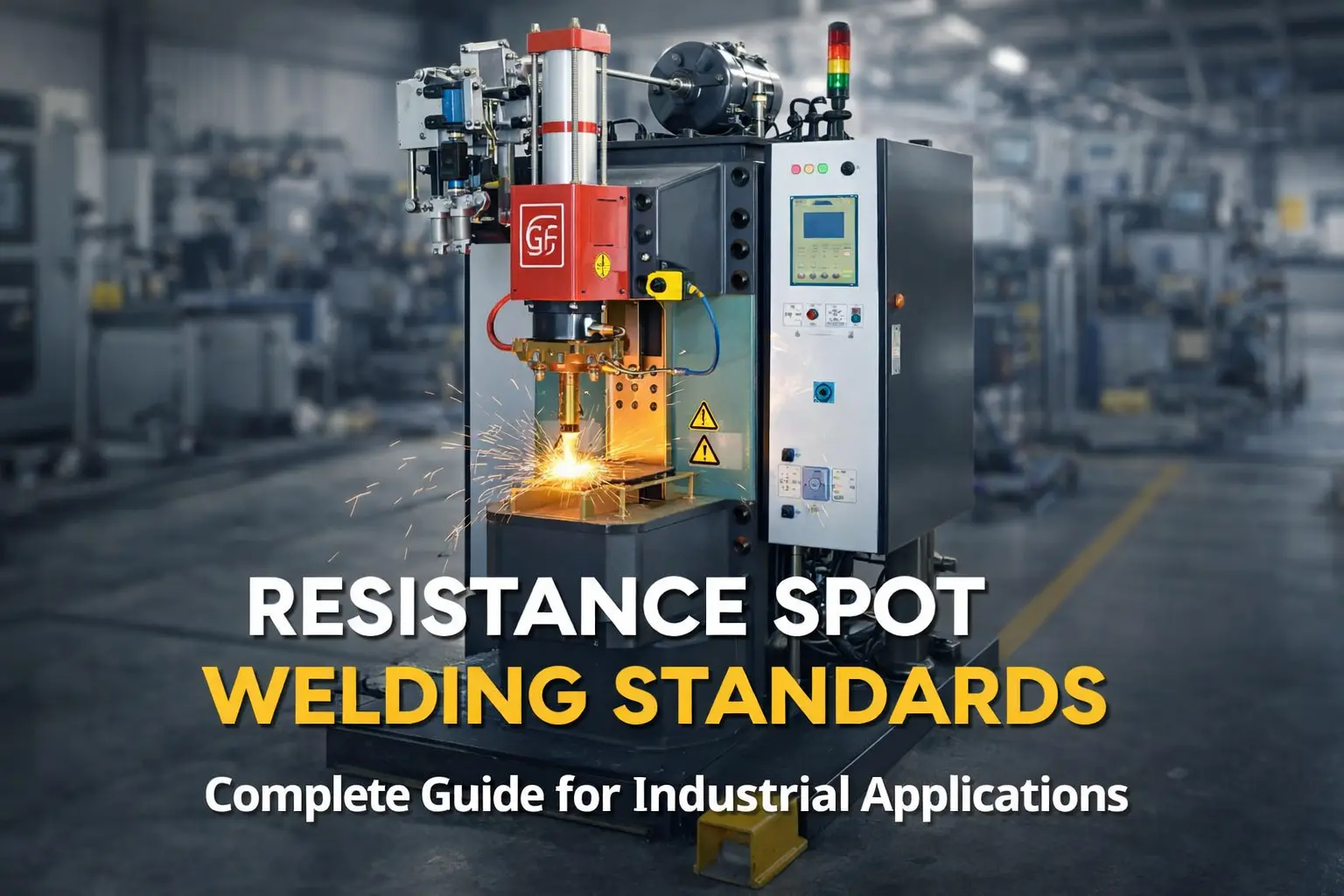
Resistance spot welding is one of the most widely used joining processes in modern manufacturing, particularly in high-volume production environments such as automotive, appliance, electrical cabinets, and sheet metal fabrication industries. It is a type of resistance welding where metal sheets are joined by applying pressure and passing a controlled electrical current through the contact point, generating heat that melts and fuses the materials at a localized spot.
For OEMs, production engineers, and automation integrators, resistance spot welding offers a highly efficient, repeatable, and cost-effective solution for mass production of sheet metal assemblies.
As global demand for precision, speed, and automation continues to grow, companies like Heron Welder are driving innovation in advanced resistance welding systems, including MFDC spot welding, projection welding, and fully automated welding lines.
What is Resistance Spot Welding?
Resistance spot welding (RSW) is a thermoelectric process in which heat is generated by electrical resistance at the interface of two overlapping metal sheets. When sufficient current and pressure are applied through copper electrodes, the metal at the interface melts and forms a “nugget” that solidifies under pressure, creating a strong joint.
Key Process Elements:
- Electrodes: Conduct current and apply pressure
- Current: High amperage, low voltage electrical pulse
- Pressure: Maintains sheet contact and controls nugget formation
- Time: Precise duration determines weld quality
This process is typically completed in milliseconds to seconds, making it ideal for automated production lines.
Working Principle of Resistance Spot Welding
The principle is based on Joule’s Law of heating:
Higher electrical resistance at the interface of two metal sheets generates heat when current passes through them. This heat is concentrated at the joint, causing localized melting.
Basic Stages of the Process:
1. Squeeze Stage
The electrodes clamp the metal sheets together with controlled force.
2. Welding Stage
A high current passes through the workpieces, generating heat at the contact point and forming a molten weld nugget.
3. Holding Stage
Pressure is maintained while the weld cools and solidifies, ensuring joint strength.
4. Release Stage
Electrodes retract after the weld is completed.
This cycle can be repeated thousands of times per hour in automated systems, making it ideal for mass production.
Advantages of Resistance Spot Welding
Resistance spot welding offers multiple benefits for industrial manufacturers:
High Production Efficiency
Spot welding can produce hundreds of welds per minute in automated setups, significantly improving throughput.
Low Operational Cost
No filler materials, shielding gases, or complex consumables are required.
Automation Compatibility
It integrates seamlessly with robotic arms and CNC-controlled production lines.
Clean and Precise Joints
Produces minimal distortion and requires little to no post-processing.
Consistency and Repeatability
Ideal for industries where uniform quality is critical, such as automotive body assembly.
Applications of Resistance Spot Welding
Resistance spot welding is widely used across various industries due to its speed and reliability.
Automotive Industry
- Car body panels
- Door assemblies
- Chassis components
- EV battery packs
Appliance Manufacturing
- Refrigerators
- Washing machines
- Air conditioning units
Electrical and Electronics
- Metal enclosures
- Switchgear panels
- Busbars and connectors
Sheet Metal Fabrication
- Cabinets and enclosures
- HVAC ducting
- Industrial machinery covers
Manufacturers rely on advanced welding systems from companies like Heron Welder to maintain production quality and reduce downtime in these demanding applications.
Types of Resistance Spot Welding Technologies
Modern manufacturing requires flexibility and precision. Several variations of spot welding exist:
1. AC Spot Welding
Uses alternating current and is suitable for basic applications, but less efficient for high-end production.
2. MFDC Spot Welding (Medium Frequency Direct Current)
Provides higher efficiency, better control, and reduced energy consumption. Widely used in automotive production lines.
3. Capacitor Discharge Welding
Delivers energy in a very short pulse, ideal for delicate or thin materials.
4. Projection Welding
Uses embossed projections on the workpiece to concentrate heat and ensure precise welding points.
Advanced manufacturers like Heron Welder specialize in MFDC systems and automated welding solutions tailored for modern factories.
Resistance Spot Welding vs Other Welding Methods
Understanding the differences between welding techniques helps manufacturers choose the right process.
Spot Welding vs MIG Welding
- Spot welding is faster and more suitable for thin sheets
- MIG welding allows continuous seams but requires filler material
Spot Welding vs TIG Welding
- Spot welding is automated and high-speed
- TIG welding offers higher precision but lower production speed
Spot Welding vs Laser Welding
- Laser welding provides deep penetration and precision
- Spot welding is more cost-effective for high-volume production
For mass production environments, resistance spot welding remains the most economical and scalable solution.
Key Process Parameters Affecting Weld Quality
Achieving consistent weld quality depends on controlling several parameters:
Current
Higher current increases heat generation but must be controlled to avoid expulsion.
Electrode Force
Proper force ensures good contact and prevents overheating.
Weld Time
Too short leads to weak joints; too long causes overheating.
Electrode Material and Shape
Copper alloys are commonly used for durability and conductivity.
Surface Condition
Clean surfaces improve conductivity and weld strength.
Advanced welding systems from Heron Welder integrate intelligent control systems that automatically adjust these parameters for optimal results.
Automation and Smart Manufacturing in Spot Welding
Modern factories are increasingly adopting automated resistance spot welding systems integrated with robotics, sensors, and PLC controls.
Benefits of Automation:
- Higher production speed
- Reduced human error
- Real-time quality monitoring
- Predictive maintenance capabilities
Automation integrators and OEMs prefer turnkey welding solutions that include welding guns, controllers, and robotic integration systems.
Companies like Heron Welder provide complete welding production line solutions designed for Industry 4.0 environments.
Best Practices for Industrial Spot Welding
To maximize efficiency and weld quality, manufacturers should follow these best practices:
- Regular electrode maintenance and dressing
- Proper alignment of welding arms and fixtures
- Consistent monitoring of current and force parameters
- Use of high-quality copper electrodes
- Integration of real-time quality inspection systems
These practices reduce defects, improve consistency, and extend equipment lifespan.
Future Trends in Resistance Spot Welding
The future of resistance spot welding is closely tied to automation, AI integration, and smart manufacturing systems.
Emerging Trends:
- AI-based weld quality prediction
- Digital twin simulation for welding processes
- Energy-efficient MFDC systems
- Fully robotic welding cells
- Integration with IoT-based factory monitoring systems
Manufacturers investing in these technologies are achieving higher productivity and lower operational costs.
FAQs on Resistance Spot Welding
1. What materials can be joined using resistance spot welding?
It is commonly used for steel, stainless steel, and some aluminum alloys, depending on machine capability.
2. Is resistance spot welding suitable for thick materials?
It is primarily used for thin to medium sheet metals, typically up to a few millimeters thick.
3. What industries use resistance spot welding the most?
The automotive industry is the largest user, followed by appliance, electrical, and metal fabrication sectors.
4. How is weld quality controlled in spot welding?
Quality is controlled through monitoring current, pressure, time, and electrode condition, often supported by automation systems.
5. What is the advantage of MFDC spot welding?
MFDC systems provide higher energy efficiency, better control, and improved weld consistency compared to traditional AC systems.
Conclusion and Call to Action
Resistance spot welding remains a cornerstone of modern industrial manufacturing due to its speed, efficiency, and adaptability to automation. As production demands increase and quality standards become stricter, manufacturers require advanced welding systems that ensure consistency, scalability, and smart control.
For OEMs, production engineers, and automation integrators looking to upgrade their welding capabilities, advanced resistance welding solutions can significantly improve productivity and reduce operational costs.
To explore customized welding systems, automated production lines, or MFDC spot welding solutions, connect with Heron Welder for expert consultation and tailored manufacturing support.




 Arabic
 French
 Spanish
 Portuguese
 Deutsch
 Turkish
 Dutch
Dutch
 Italiano
 Russian
 Romaian
 Portuguese (Brazil)
 Greek
Greek