


Technical Causes of Clutch Release Bearing Failure: Root Cause Analysis
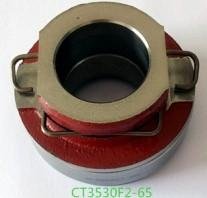
In high-torque B2B environments and heavy-duty automotive applications, the clutch release bearing (or throw-out bearing) is the primary interface between the stationary actuation system and the rotating pressure plate. When this component fails, it often leads to total drivetrain immobilization. Understanding the mechanical "why" behind these failures is essential for preventing unplanned maintenance and extending the service life of industrial transmissions.
1. Thermal Degradation of High-Pressure Grease
The most common technical failure point is the breakdown of the internal lubricant. As the bearing maintains contact with the spinning diaphragm spring, friction generates significant thermal energy. If the operating temperature exceeds the grease’s "drop point," the base oil separates from the thickener. This lubrication starvation leads to metal-on-metal contact, causing the internal ball bearings to weld to the race under high-speed rotation.
2. Axial Misalignment and Edge Loading
Precision alignment is critical during the assembly of a clutch system. If the transmission input shaft is not perfectly concentric with the crankshaft, the clutch release bearing experiences uneven edge loading. Instead of the axial force being distributed across the entire raceway, the load concentrates on a small arc. This localized stress exceeds the material’s yield strength, resulting in rapid surface fatigue and "spalling" of the bearing steel.
3. Diaphragm Spring Harmonic Vibration
Manual and automated-manual transmissions often suffer from harmonic vibrations. When the release bearing is partially engaged, these vibrations cause the balls to "chatter" against the races. This creates microscopic indentations known as false brinelling. These "speed bumps" within the raceway increase friction and noise, leading to a feedback loop of heat and vibration that eventually shatters the bearing cage.
4. Centrifugal Grease Displacement
In high-RPM industrial applications, centrifugal force becomes a major technical challenge. If the bearing is not designed with specialized high-speed seals, the internal grease is flung toward the outer diameter of the housing. This leaves the inner raceway—where the actual rolling contact occurs—completely dry. Without a consistent lubricating film, the bearing will overheat and seize within a matter of hours.
5. Contamination by Friction Material Dust
As the clutch disc wears down, it releases a fine, abrasive dust made of organic or ceramic fibers. If the clutch release bearing's seals are compromised, this dust enters the bearing housing and mixes with the grease. This mixture acts as a "lapping compound," grinding away the polished finish of the balls and races. Once the surface roughness increases, the bearing's friction coefficient spikes, ending its functional life.
Conclusion
Solving clutch release bearing failures requires a deep understanding of thermodynamics, lubrication chemistry, and precision mechanical alignment. By addressing these specific technical issues during the design and installation phases, manufacturers can significantly enhance the reliability of their drivetrain systems.
Enhance your industrial precision with NMR Bearing. Visit nmrbearing.com to explore our premium micro displays and optoelectronic solutions. Our expert engineering team provides high-performance B2B products to solve your needs.

 English
 Arabic
 French
 Spanish
 Portuguese
 Deutsch
 Turkish
 Dutch
Dutch
 Russian
 Romaian
 Portuguese (Brazil)
 Greek
Greek