


Mastering Projection Welding: Efficient Metal Joining for Modern Manufacturing
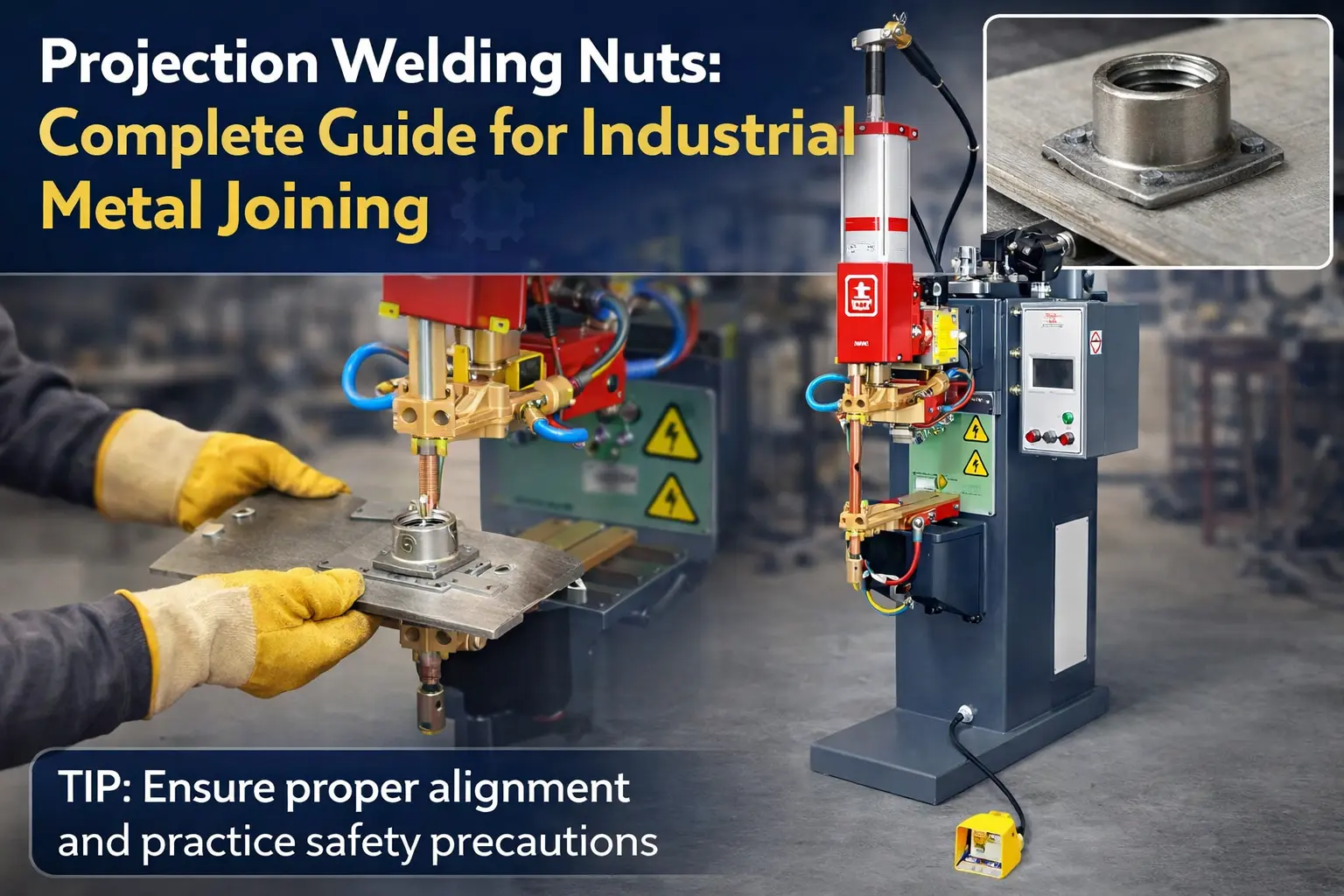
In today’s fast-paced manufacturing environment, precision, efficiency, and repeatability are paramount. Projection welding, a specialized form of resistance welding, has become a cornerstone technology for industries ranging from automotive to heavy machinery. By focusing current flow through pre-defined projections on a workpiece, manufacturers achieve strong, consistent welds with minimal material distortion making it ideal for high-volume production lines.
At Heron Welder, we deliver advanced projection welding machines, controllers, and automation systems designed to maximize productivity and reliability for OEMs, factory engineers, and integration specialists.
What is Projection Welding?
Projection welding is a resistance welding process where current passes through specific raised areas or “projections” on one or both metal components. Unlike traditional spot welding, the projections localize heat and pressure, ensuring weld formation only occurs at these predefined points.
Key Principles of Projection Welding:
- Localized Heating: Projections concentrate electrical resistance, generating heat precisely where the weld is needed.
- Controlled Force: Mechanical pressure ensures proper fusion of materials without excessive deformation.
- Repeatability: Predefined projections allow consistent welds in high-volume automated operations.
This precision makes projection welding ideal for complex assemblies and components that require uniform strength across multiple joints.
Common Applications of Projection Welding
Projection welding is widely adopted in industries where accuracy, strength, and speed are critical:
1. Automotive Manufacturing
- Fastening brackets, clips, and electrical contacts.
- Joining structural components where minimal distortion is essential.
2. Electrical and Electronics
- Connecting busbars, terminals, and components in transformers and switchgear.
- Achieving high-quality welds for battery packs and electrical assemblies.
3. Heavy Equipment and Machinery
- Welding reinforced plates and gussets.
- Fabricating structural frames with multiple weld points simultaneously.
4. Sheet Metal Fabrication
- Attaching nuts, studs, and other fittings to sheet metal efficiently.
- Ideal for high-volume production with automated press lines.
At Heron Welder, our projection welding systems cater to these applications with precision, modularity, and automation-ready designs.
Projection Welding vs Spot Welding: Key Differences
Though often compared to spot welding, projection welding offers distinct advantages:
| Feature | Spot Welding | Projection Welding |
|---|---|---|
| Heat Focus | Entire electrode contact area | Only raised projections |
| Material Distortion | Higher | Lower |
| Weld Count | Limited per cycle | Multiple welds per cycle |
| Automation | Possible | Ideal for automated lines |
| Component Complexity | Simple sheets | Brackets, nuts, studs, projections |
Projection welding excels in applications requiring multiple, simultaneous welds, precise control, and minimal deformation making it the preferred choice for high-volume manufacturing.
Best Practices for Projection Welding
To optimize projection welding operations, manufacturers should follow these best practices:
- Projection Design: Ensure projections are correctly sized and positioned for uniform current flow and consistent welds.
- Material Preparation: Clean surfaces reduce resistance variability and improve weld quality.
- Electrode Maintenance: Proper electrode shape and alignment extend life and maintain consistent weld quality.
- Parameter Optimization: Adjust current, force, and time according to material type and thickness.
- Automation Integration: Incorporate projection welding machines with automated handling systems for high throughput and repeatable results.
At Heron Welder, we provide customized solutions, including MFDC and capacitor discharge projection welders, with intelligent controllers to ensure optimal weld quality and process repeatability.
Why Choose Heron for Projection Welding Solutions?
- Comprehensive Expertise: Global experience in resistance welding, clinching, and self-pierce riveting.
- Customizable Machines: Projection welding systems tailored to your materials, geometry, and production volume.
- Automation-Ready: Fully compatible with robotic arms, conveyors, and integrated production lines.
- Advanced Control Systems: Real-time monitoring, data logging, and process optimization for consistent quality.
- After-Sales Support: Dedicated service and maintenance programs to ensure uptime and performance.
By partnering with Heron, manufacturers gain not only high-quality machines but also engineering expertise to design, implement, and optimize automated welding operations.
FAQs About Projection Welding
1. What materials can be welded with projection welding?
Projection welding works best with ferrous and non-ferrous metals, including steel, stainless steel, copper, and aluminum alloys, depending on projection design and welding parameters.
2. How does projection welding improve production efficiency?
By welding multiple points simultaneously and reducing distortion, projection welding minimizes rework and cycle times, making it ideal for automated mass production.
3. Can projection welding be automated?
Yes. Projection welding is highly compatible with robotic handling, conveyors, and integrated automation systems for high-throughput manufacturing.
4. How is weld quality controlled?
Modern projection welders from Heron incorporate intelligent controllers that monitor current, force, and weld time, providing real-time feedback and data logging for quality assurance.
5. Is projection welding suitable for thin sheets?
Yes, with proper projection design and parameter adjustment, projection welding can join thin sheets without excessive distortion or burn-through.
Take Your Manufacturing to the Next Level
Investing in projection welding technology can significantly improve production speed, precision, and product reliability. Heron Welder offers a complete range of projection welding machines, controllers, and automated solutions tailored to your factory’s specific needs.
Whether you are an OEM, manufacturing engineer, or automation integrator, our team can help design and implement a projection welding system that delivers consistent, high-quality welds while maximizing efficiency.
Request a quote today or consult Heron for a customized projection welding solution that enhances your production line and drives operational excellence.

 English
 Arabic
 French
 Portuguese
 Deutsch
 Turkish
 Dutch
Dutch
 Italiano
 Russian
 Romaian
 Portuguese (Brazil)
 Greek
Greek