


Haptic Technology Market: Transformative Innovations, Strategic Shifts, and Global Growth Pathways to 2034
The Haptic Technology Market continues to evolve as a central force shaping modern digital interaction. Integrating tactile feedback into devices, interfaces, and systems that people use every day has transformed how humans communicate with technology. Whether through subtle smartphone vibrations, immersive VR gloves, or precision-driven medical simulators, haptics has become the bridge that connects digital experiences with the physical world.
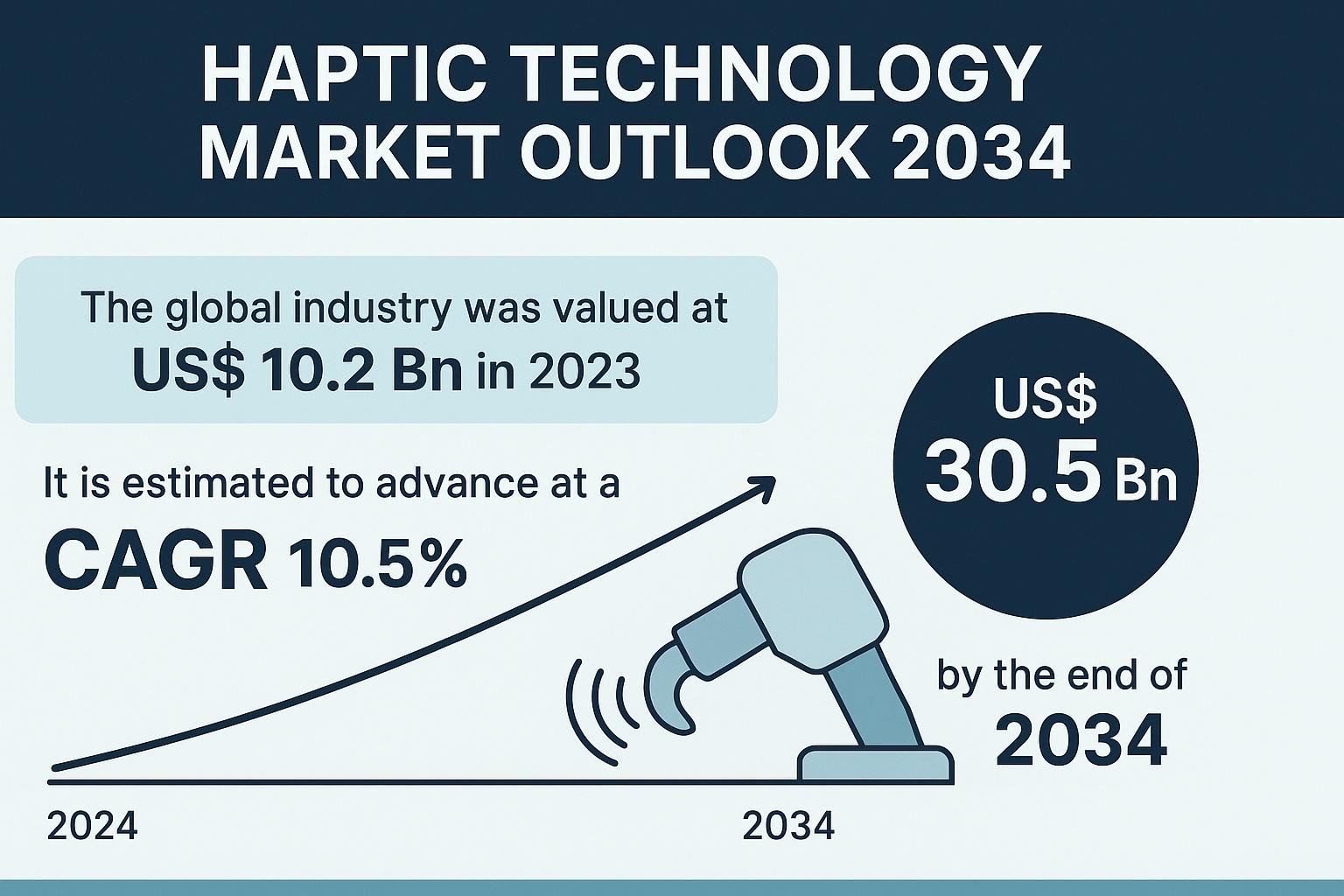
The market was valued at US$ 10.2 Bn in 2023 and is projected to reach US$ 30.5 Bn by 2034, registering a remarkable CAGR of 10.5%. This exponential growth is underpinned by advancements in actuator technologies, AI-driven feedback systems, expanding immersive applications, and the rising sophistication of consumer electronics.
This article offers an in-depth exploration of the global haptic technology market, analyzing growth trends, innovation pathways, regional dynamics, strategic developments, and emerging opportunities expected to reshape the industry over the next decade.
Introduction: Why Haptic Technology Matters Today
As digital interactions become increasingly sophisticated, the need for tactile reinforcement has grown significantly. Haptic technology adds a sense of touch, vibration, pressure, or force to digital interfaces, enabling users to feel responses that mirror real-life sensations.
This transformation has redefined user experience across:
-
Smartphones and tablets
-
Smartwatches and fitness trackers
-
Automotive control systems
-
Virtual and augmented reality platforms
-
Robotics and industrial machinery
-
Medical training simulators
In essence, haptic technology strengthens emotional engagement, improves interface accuracy, enhances safety, and boosts user satisfaction.
Market Overview: A Multi-Sensory Future
The rise of haptic systems aligns with broader digital transformation trends, particularly the shift toward natural, intuitive, and immersive user experiences. Several industries are rapidly incorporating tactile feedback to augment performance, realism, precision, and interactivity.
Key Market Statistics (2023–2034):
-
2023 Market Value: US$ 10.2 Bn
-
2034 Market Forecast: US$ 30.5 Bn
-
CAGR: 10.5%
-
Leading Region: Asia Pacific (40.8% share in 2023)
-
Dominant Industry: Consumer Electronics
-
Largest Device Segment: Active haptic devices
The next decade will be defined by breakthroughs in micro-actuators, AI-calibrated tactile outputs, wearable haptic systems, and immersive environments that demand realistic interactive touch.
Market Drivers: What’s Fueling Growth?
1. The Explosion of Immersive Technologies (AR/VR/MR)
As the metaverse, VR headsets, and AR overlays become more prevalent, the need for lifelike tactile sensations skyrockets. Haptic gloves, vests, and suits allow users to feel textures, heat, pressure, and impact — turning virtual worlds into physically responsive experiences.
Applications include:
-
VR gaming
-
Virtual retail shopping
-
Simulation-based corporate training
-
Defense and tactical training
-
Virtual tourism
-
Remote industrial maintenance
The demand for realistic feedback effects is expected to be one of the strongest growth engines through 2034.
2. Consumer Electronics Drive Mainstream Adoption
Consumer electronics remain the largest revenue-generating segment due to the sheer volume of devices requiring haptic components.
Examples include:
-
Smartphone haptic engines for keyboard clicks, alerts, and gaming
-
Smartwatch vibration nudges for notifications and health reminders
-
Haptic-enabled earbuds for gesture control
-
Gaming controllers with multi-directional force feedback
With new device launches increasingly integrating customizable tactile effects, this segment will continue to dominate overall market share.
3. Automotive Haptics for Safety and User Interface Enhancement
The automotive industry is rapidly transitioning to touch-driven dashboards, digital climate controls, and interactive infotainment systems.
Haptics improve driver safety by enabling eyes-free interaction, reducing the need to visually confirm inputs.
Examples include:
-
Haptic steering wheels with vibration alerts
-
Tactile gear shifters and control knobs
-
Haptic-enabled infotainment touchscreens
-
Driver assistance alerts
As electric vehicles (EVs) introduce more connected features, the demand for advanced haptic interfaces is expected to increase dramatically.
4. Medical and Surgical Advancements Using Haptic Systems
The healthcare sector is one of the fastest-growing adopters of haptic technology.
Applications include:
-
Surgical training simulators
-
Robotic-assisted surgeries with force feedback
-
Haptic-enabled rehabilitation gloves
-
Dental training systems
-
Physical therapy devices
Haptic-enabled medical systems enhance accuracy, reduce training risks, and improve patient and practitioner outcomes. This segment is forecast to grow rapidly as robotic surgeries and VR-based training rise worldwide.
Market Segmentation Analysis
1. By Device Type
Active Haptic Devices (61.6% share in 2023)
Active devices produce real-time tactile sensations using electromechanical actuators. They are widely used in:
-
Smartphones
-
Gaming controllers
-
VR gloves
-
Medical simulators
-
Automotive dashboards
Continuous advancements in piezoelectric and LRA technologies are pushing the boundaries of performance and miniaturization.
Passive Haptic Devices
These rely on material resistance or mechanical designs to simulate tactile effects. They are used in cost-sensitive applications or basic equipment.
2. By Feedback Type
Tactile Feedback (85.9% share in 2023)
The most widely adopted type, tactile feedback includes vibrations, textures, and surface effects.
Used heavily in:
-
Smartphones
-
VR devices
-
Automotive panels
-
Wearables
Force Feedback
Simulates resistance and force, essential for:
-
Robotic surgery systems
-
Industrial machinery
-
Flight simulators
-
Training simulators
3. By Component
Hardware
Includes actuators, controllers, drivers, and sensors. Hardware dominates market share due to its critical importance in creating physical sensations.
Software
Controls the intensity, duration, direction, and pattern of feedback. AI-driven software is the next frontier in haptic optimization.
4. By End-use Industry
-
Consumer Electronics
-
Healthcare & Medical
-
Automotive & Transportation
-
Industrial and Commercial
-
Education & Research
-
Others
Consumer electronics dominate, but healthcare and automotive are the fastest-growing.
Regional Insights: Global Expansion Patterns
Asia Pacific – The Global Leader (40.8% market share)
Driven by strong consumer electronics manufacturing in:
-
China
-
Japan
-
South Korea
-
India
The region benefits from massive smartphone production and strong VR/AR adoption.
North America – Innovation Hub
Key drivers:
-
Advanced healthcare simulation adoption
-
VR/AR innovation clusters
-
High gaming consumption
The U.S. leads regional adoption due to its strong tech ecosystem.
Europe – Automotive Integration Leader
European automakers are at the forefront of applying haptics in digital cockpits and smart dashboards.
Countries like Germany, France, and the U.K. contribute significantly.
Technological Trends Shaping the Future
1. Multi-Sensory Haptics for Realistic Digital Experiences
Combining temperature control, vibration, motion, and resistance provides rich sensory layers.
2. AI-Enabled Haptic Feedback
Machine learning tailors tactile responses to user patterns, improving personalization.
3. Micro-Actuators for Ultra-Thin Devices
Extremely compact actuators enable haptic capabilities in foldable phones and slim wearables.
4. Mid-Air Haptics
Ultrasonic waves create tactile effects without touching a surface — ideal for sterile environments and immersive XR.
5. Wearable Haptic Suits
Full-body tactile wearables for gaming, therapy, security training, and remote operations are rapidly advancing.
Competitive Landscape
Key companies active in the global haptic technology market include:
-
AITO BV
-
Boréas Technologies
-
Cirrus Logic Inc.
-
hap2U
-
Immersion Corporation
-
Johnson Electric Holdings Limited
-
KEMET Corporation
-
Microchip Technology Inc.
-
onsemi
-
Renesas Electronics Corporation
-
Synaptics Incorporated
-
TDK Corporation
-
Texas Instruments Incorporated
Key Strategic Updates (2023):
-
AITO BV: Launched an ultra-compact high-performance touchpad for laptops.
-
Boreas Technologies: Released the HapticStudio SDK to empower developers to build high-fidelity CapDrive haptic effects.
-
TDK Corporation: Introduced new PowerHap piezo actuator starter kits for advanced haptic prototyping.
These developments reflect a growing industry emphasis on miniaturization, energy efficiency, developer-friendly tools, and premium tactile quality.
Challenges and Market Restraints
Despite strong growth prospects, the market faces certain challenges, including:
1. High Costs of Advanced Actuators
Premium piezoelectric components are expensive, limiting adoption in low-cost segments.
2. Complex Integration With Software
Synchronizing tactile effects with audio and visual cues requires extensive engineering and optimization.
3. Limited Awareness in Emerging Industries
Industrial and enterprise users in emerging economies remain unfamiliar with advanced haptic solutions.
4. Power Consumption Constraints
Some high-performance haptic systems require significant energy.
However, ongoing R&D is progressively addressing these barriers.
Future Opportunities: The Road to 2034
1. The Metaverse and Extended Reality (XR)
Haptic interfaces will play a critical role in enabling lifelike virtual touch.
2. Autonomous Vehicles
Haptic cues will be essential in enhancing safety alerts and communication between vehicle systems and passengers.
3. Smart Manufacturing and Industry 4.0
Haptic sensors will support remote equipment management, robotics, and AR-guided maintenance.
4. Personalized Medicine and Rehabilitation
Haptic devices will assist patients with sensory deficits, motor disabilities, and stroke recovery.
5. E-Learning and Digital Classrooms
Immersive haptic-enabled learning modules will enhance practical skill acquisition.
To capitalize on these opportunities, industry stakeholders must invest in multi-sensory systems, actuator innovation, and haptic AI engines.
Conclusion
The Haptic Technology Market is on a powerful upward trajectory, driven by immersive digital experiences, technological breakthroughs, increasing adoption across industries, and growing demand for intuitive human–machine interaction. As tactile interfaces evolve into highly sophisticated systems powered by AI, micro-actuation, and VR/AR ecosystems, haptic technology will become a cornerstone of next-generation digital engagement. Companies that invest in innovation, expand strategic partnerships, and penetrate emerging applications will shape the future of this high-growth market.

 English
 Arabic
 French
 Portuguese
 Deutsch
 Turkish
 Dutch
Dutch
 Italiano
 Russian
 Romaian
 Portuguese (Brazil)
 Greek
Greek